






Youth Digital ICT Skills Training, Job Readiness & Entrepreneurship Empowerment Programme, KWT
From Learning to Employment, From Ideas to Enterprise.

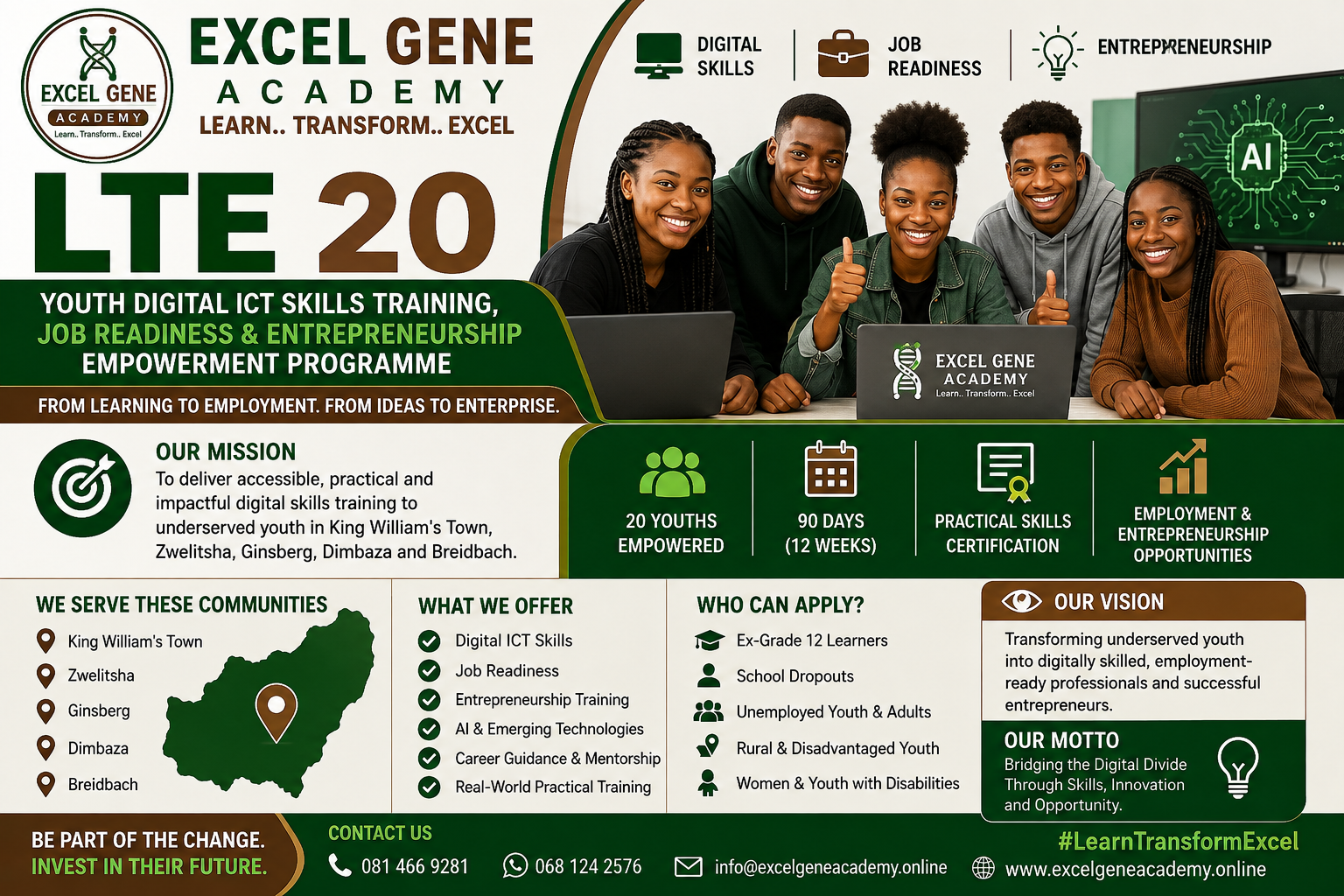
Excel Gene Academy proudly presents LTE 20 — the Youth Digital ICT Skills Training, Job Readiness and Entrepreneurship Empowerment Programme — a focused, high-impact 12-week (90-day) initiative designed to bridge the digital divide and create equal opportunity for 20 unemployed young people in King William's Town, Dimbaza, Zwelithsa, Ginsberg, and its surrounding communities.
In today's economy, digital skills are no longer optional — they are essential for education, employment and entrepreneurship. Yet thousands of young people across the Buffalo City Metro area remain excluded from the digital economy due to a lack of access, training and exposure.
LTE 20 addresses this gap by providing direct access to digital tools and connectivity at the Excel Gene Academy campus. Lack of Digital Education Basic computer operation (typing, using software), Navigating the internet, using email and online communication tools, Understanding digital safety and responsibility
Excel Gene Academy's programme focuses on practical, hands-on training; ensuring participants not only learn but confidently apply digital skills in real-life situations.
THE NEED
LTE 20 seeks to contribute to the lives of young people who are: Digitally capable | Employable | Entrepreneurial | Financially responsible | Adaptable | Lifelong learners
High Unemployment Due to Skills Gaps
Unemployment among youth in the Eastern Cape is driven largely by a mismatch between available jobs and available skills. LTE 20 directly addresses employability by equipping participants with job-ready ICT skills, teaching online job search and application processes, and building the confidence needed to operate in modern workplaces. Current Eastern Cape unemployment reached 47.5% according to Statistics South Africa's Q2 2026 Quarterly Labour Force Survey.
Many young people require practical skills that complement formal education and improve their ability to participate in the modern economy.
LTE 20 focuses on practical areas including:
- Computer literacy
- Microsoft Office and productivity tools
- Internet and online tools
- Coding and website development
- Artificial Intelligence
- Job readiness
- Customer service
- Cashier and POS skills
- Digital entrepreneurship
- Financial literacy
- Personal discipline and development
The programme therefore seeks to bridge the gap between learning, practical skills and economic participation.
TARGET BENEFICIARIES
Ex-Grade 12 Learners
Many matriculants struggle to transition into employment or higher education due to a lack of digital skills. LTE 20 provides practical ICT competencies that improve their career prospects.
School Dropouts
For individuals who did not complete formal schooling, digital literacy offers an alternative pathway to skills development, employability and self-improvement.
Unemployed Youth & Adults
LTE 20 equips unemployed participants with relevant digital skills that increase their chances of securing employment or starting a small business.
Rural Communities in the Eastern Cape
Participants from rural areas surrounding King William's Town — including Zwelitsha, Ginsberg, Dimbaza and Breidbach — often lack access to digital infrastructure. LTE 20 ensures they receive equal opportunity to develop digital competencies at the Excel Gene Academy campus.
Financially Disadvantaged Individuals
By offering LTE 20 free of charge to selected beneficiaries, Excel Gene Academy removes financial barriers, ensuring inclusivity and equal access to learning opportunities.
TRAINING DELIVERY MODEL
All LTE 20 training is delivered at the Excel Gene Academy campus in King William's Town, providing a structured learning environment with access to computers, internet and qualified facilitators.
On-Site Training at the Academy
LTE 20 will be delivered at the Excel Gene Academy campus in King William's Town, providing:
- Access to computers, internet and learning tools many participants do not have at home
- A safe, supportive learning environment where participants can focus, practice and grow
- Direct interaction with trained facilitators who guide learners step-by-step
- A structured curriculum that builds skills progressively from basic to advanced
All LTE 20 training is delivered at the Excel Gene Academy campus in King William's Town, providing a structured learning environment with access to computers, internet and qualified facilitators. Participants benefit from face-to-face guidance, peer interaction and hands-on learning.
- Conducted at the Excel Gene Academy campus
- Structured classroom environment
- Access to equipment and trained facilitators
Community Reach
Recruitment and outreach for LTE 20 extend into Zwelitsha, Ginsberg, Dimbaza and Breidbach, ensuring young people from these communities are made aware of, and supported to attend, training at the King William's Town campus.
BENEFITS TO SPONSORS & PARTNERS
A contribution to LTE 20 is an investment in digital inclusion, youth development, employability, entrepreneurship and community capacity building.

Why Local Companies in King William’s Town/Qonce Should Partner with LTE 20
Supporting the Excel Gene Academy LTE 20 Youth Skills Programme gives local companies an opportunity to invest directly in the young people and future economic potential of the King William’s Town/Qonce community.
1. Make a Direct Local Community Impact
Your company's contribution can directly support young people from the local community by providing access to practical digital, ICT, employment and entrepreneurship skills.
Instead of supporting a broad programme with limited local visibility, companies can see how their contribution is helping develop skills within the community in which they operate.
2. Strengthen Your CSI & ESG Contribution
Demonstrate meaningful commitment to Corporate Social Investment (CSI) and relevant Environmental, Social and Governance (ESG) priorities, particularly youth development, education, digital inclusion, employability and community development.
3. Invest in Local Youth Skills
Help young people develop practical skills in:
- Computer literacy
- Microsoft Office
- Internet and online tools
- Artificial Intelligence
- Coding and website development
- Job readiness
- Customer service
- Cashier and POS skills
- Digital entrepreneurship
- Financial literacy
- Personal development
This creates a stronger foundation for young people seeking employment, further education or self-employment.
4. Contribute to Local Economic Development
By supporting skills development, companies can contribute to a local environment where young people are better prepared to participate in the economy.
LTE 20 encourages participants to explore both employment and entrepreneurship, helping them identify ways to turn skills into economic opportunities.
5. Help Build a Future Local Talent Pipeline
Local businesses need people with practical digital and workplace skills.
Through LTE 20, companies can support the development of young people who may eventually become:
- Employees
- Interns
- Entrepreneurs
- Service providers
- Suppliers
- Business partners
- Future industry professionals
This creates an opportunity for local companies to engage with emerging talent within the community.
6. Strengthen Community Relationships
A partnership with LTE 20 can strengthen relationships between your company and:
- Local youth
- Families
- Schools and education stakeholders
- Community organisations
- Local businesses
- Government and development stakeholders
- Skills-development partners
It demonstrates that your organisation is actively participating in the development of the community where it operates.
7. Demonstrate Measurable Social Impact
Sponsors can receive structured information on programme activities and outcomes, including:
- Number of youth supported
- Training attendance
- Skills modules completed
- Certificates issued
- Practical projects completed
- Employment-readiness activities
- Entrepreneurship activities
- Participant success stories
- Further-learning opportunities
- Employment or business-development outcomes where available
This enables companies to document and communicate the impact of their CSR investment.
8. Receive Programme & Impact Reporting
Excel Gene Academy can provide sponsors with appropriate programme, financial and impact reports, supported where applicable by:
- Participant statistics
- Programme progress
- Photographic documentation
- Success stories
- Training activities
- Certificates and graduation information
- Impact summaries
This provides sponsors with evidence of how their support has contributed to the programme.
9. Community Visibility & Recognition
Subject to the agreed sponsorship arrangement and appropriate consent, sponsors can be recognised through:
- LTE 20 programme materials
- Graduation ceremonies
- Community engagement activities
- Sponsor recognition events
- Digital and social-media communication
- Programme success stories
- Media opportunities where available
This provides an opportunity for companies to demonstrate their contribution to local youth development.
10. Support Digital Transformation
LTE 20 introduces young people to technologies increasingly relevant to education, employment and business, including:
ICT + Internet + AI + Coding + Digital Business + Online Learning
Companies therefore contribute to expanding digital access and digital skills within the local community.
11. Support National Development Priorities
The programme contributes to broader objectives around:
- Youth skills development
- Digital inclusion
- Employability
- Entrepreneurship
- Education
- Economic participation
- Lifelong learning
It provides a practical local platform through which companies can contribute to these development priorities.
12. Create Opportunities for Employee Engagement
Where appropriate, corporate partners can involve their employees through:
- Mentorship
- Career talks
- Skills workshops
- CV and interview preparation
- Entrepreneurship mentorship
- Workplace exposure
- Industry presentations
This allows employees to contribute their professional knowledge while engaging directly with local youth.
13. Strengthen the Local Business Ecosystem
Supporting youth skills development can contribute to a stronger local ecosystem of skilled workers, entrepreneurs, digital service providers and emerging businesses.
Sponsor Value & Recognition
Subject to the agreed sponsorship arrangement, Excel Gene Academy can provide:
- Sponsor acknowledgement in programme materials
- Recognition at programme events
- Certificates and programme documentation acknowledging support
- Sponsor logo placement where appropriate
- Impact reports
- Beneficiary statistics
- Programme photographs, subject to appropriate consent
- Success stories and case studies
- CSR impact documentation
Benefits to Beneficiaries
Every sponsored learner will receive:
- A fully funded 12-week (90-day) ICT Skills Training Programme
- Practical, hands-on digital skills training delivered by qualified facilitators
- Daily lunch and tea refreshments during training
- Transportation support to improve attendance and reduce financial barriers
- Training manuals, software resources, flash drives, learning materials and practical tools
- Career guidance, job readiness training and digital entrepreneurship exposure
- A recognised certificate upon successful completion
- Increased confidence, employability and opportunities for further education, employment or self-employment
Benefits to Communities
The impact of LTE 20 extends well beyond the classroom. Every trained participant becomes a source of knowledge, inspiration and positive change within their family and community across King William's Town, Zwelitsha, Ginsberg, Dimbaza and Breidbach.
- Increased digital literacy and access to technology
- Reduced barriers to employment and education
- Greater participation in the digital economy
- Empowered youth equipped to contribute to local development
- Enhanced entrepreneurial activity and small business growth
- Stronger, more resilient communities capable of embracing technological change
- Reduced social inequality through equitable access to digital opportunities
PROGRAM OBJECTIVES
The LTE 20 Implementation Plan provides a practical framework for delivering youth skills training through structured learning, practical activities, assessment, career development and entrepreneurship exposure.

By the end of the 12-week programme, participants will:
-
Develop practical digital literacy among young people.
- Improve participants' ICT and workplace skills.
- Introduce young people to Artificial Intelligence and emerging technologies.
- Develop basic coding, website and digital-development skills.
- Improve employment readiness.
- Encourage entrepreneurship and self-employment.
- Promote responsible financial management.
- Encourage lifelong digital learning.
- Build confidence, discipline and personal responsibility.
- Connect participants to further education, employment and business opportunities.
PROGRAMME FOCUS AREAS

- DIGITAL LITERACY & COMPUTER SKILLS
The programme provides participants with practical foundational computer skills required for education, employment, entrepreneurship and everyday digital activities.
Key areas include:
- Computer fundamentals and operating systems
- Keyboarding and typing skills
- File and folder management
- Microsoft Word
- Microsoft Excel
- Microsoft PowerPoint
- Microsoft Access
- Desktop Publishing
- Basic computer troubleshooting
- Safe and responsible use of computers
Focus: Build confidence and independence in using computers and digital devices.
- DIGITAL SKILLS & ONLINE PRODUCTIVITY TOOLS
Participants develop practical skills for navigating and using the digital environment effectively.
Key areas include:
- Internet browsing and online research
- Email creation and professional email communication
- Google Workspace
- Google Drive and cloud storage
- Online collaboration tools
- Online forms and applications
- Digital communication
- Information searching and evaluation
- E-commerce and online transactions
- Digital productivity tools
Focus: Enable young people to access information, communicate, collaborate and work productively online.
- CODING, WEBSITE & MOBILE APP DEVELOPMENT
This focus area introduces participants to technology development and computational thinking.
Key areas include:
- Introduction to coding
- Computational and logical thinking
- Beginner programming concepts
- HTML and website fundamentals
- Basic website development
- Introduction to mobile application development
- Digital projects and problem-solving
- Technology innovation
Focus: Introduce young people to technology careers and encourage creativity, innovation and problem-solving.
- ARTIFICIAL INTELLIGENCE & EMERGING TECHNOLOGIES
Participants receive practical exposure to Artificial Intelligence and emerging technologies and learn how these tools can be used responsibly.
Key areas include:
- Introduction to Artificial Intelligence
- AI tools and applications
- Prompt writing and effective AI interaction
- AI for education and learning
- AI for employment and career development
- AI for entrepreneurship
- AI for customer service
- AI for business operations
- Responsible and ethical use of AI
- Introduction to emerging digital technologies
Focus: Help participants understand and practically apply emerging technologies in education, employment, business and everyday life.
- JOB READINESS & ICT EMPLOYABILITY SKILLS
The programme prepares participants for participation in the modern workplace by combining digital competencies with practical employability skills.
Key areas include:
- CV development
- Cover letters and professional applications
- Online job searching
- Online job applications
- Emailing employers professionally
- Interview preparation
- Workplace digital communication
- Customer service
- Cashier and Point-of-Sale skills
- Basic office administration
- Workplace etiquette
- Teamwork and communication
Focus: Improve participants' readiness to seek employment and function effectively in digitally enabled workplaces.
- DIGITAL ENTREPRENEURSHIP
Participants are introduced to the use of digital technology to establish, promote and operate small businesses.
Key areas include:
- Introduction to digital entrepreneurship
- Identifying business opportunities
- Social media marketing
- Content creation
- Digital branding
- Online customer engagement
- E-commerce
- Digital business communication
- Online service delivery
- Exploring legitimate digital income opportunities
- Using AI and digital tools in small businesses
Focus: Encourage participants to use technology as a tool for entrepreneurship, innovation and income generation.
- DIGITAL EDUCATION & LIFELONG LEARNING
LTE 20 promotes continuous learning by helping participants use online resources to develop their knowledge and skills beyond the classroom.
Key areas include:
- Online learning platforms
- Digital libraries and educational resources
- Online courses
- Self-directed learning
- Research and information skills
- Digital certification opportunities
- Skills development platforms
- Learning management systems
- Educational applications and productivity tools
Focus: Create a culture of lifelong learning and encourage participants to continuously upgrade their skills.
- SMALL BUSINESS START-UP OPPORTUNITIES
Participants are exposed to practical local business opportunities that can be started with appropriate planning, skills and available resources.
Key areas include:
- Identifying local market needs
- Business idea generation
- Basic business planning
- Start-up requirements
- Pricing and costing
- Customer identification
- Basic marketing
- Record keeping
- Digital promotion
- Small-business financial management
- Formalisation and responsible business practices
Focus: Encourage self-reliance by helping young people understand how skills can be converted into sustainable small-business opportunities.
- FINANCIAL LITERACY & MONEY MANAGEMENT
Financial education helps participants develop responsible financial habits and understand basic financial systems.
Key areas include:
- Personal budgeting
- Saving
- Financial planning
- Money management
- Financial discipline
- Needs versus wants
- Understanding bank accounts
- Financial institutions
- Responsible use of loans and credit
- Basic interest concepts
- Debt awareness
- Personal financial goals
- Introduction to business finances
Focus: Develop financially responsible young people who can make informed decisions about their personal and business finances.
- PERSONAL DISCIPLINE & SKILLS DEVELOPMENT
The programme recognizes that technical skills must be supported by personal development, discipline and responsible decision-making.
Key areas include:
- Personal responsibility
- Goal setting
- Time management
- Self-discipline
- Positive decision-making
- Communication skills
- Confidence building
- Problem-solving
- Leadership
- Teamwork
- Adaptability
- Professional conduct
- Personal presentation
- Continuous self-improvement
Focus: Guide participants to take greater responsibility for their personal development and make constructive choices that increase their value in society and the workplace.